
This article is part of our newest special section on museums, which focuses on new artists, new audiences and new ways of thinking about exhibitions.
Raphael Montañez Ortiz was a celebrated avant-garde artist in 1969 when he helped a group of parents, teachers, and students from East Harlem found El Museo del Barrio, a museum he believed would welcome Latin American artists more welcome as New York’s established temples of fine arts.
He left El Museo in 1971 and resumed his groundbreaking career as an artist while also accepting a tenure track teaching position at Rutgers University. Now, the man and the museum reunite in a comprehensive retrospective of Mr. Montañez Ortiz’s 60-year career.
The exhibition “Raphael Montañez Ortiz – A Contextual Retrospective” opened at El Museo del Barrio on April 14 and is scheduled to run until September 11. It then moves to the Museo Tamayo in Mexico City.
Ideally, the show will reintroduce a widely respected, new-generation Latino artist to his hometown and raise the profile of the museum he founded to connect Latino students with the arts.
Chon A. Noriega, professor of film and media studies at the UCLA School of Theatre, Film and Television, said this show exemplifies why specialty museums are important in expanding appreciation of art.
“We all need museums. We need every kind of museum that is possible,” he said.
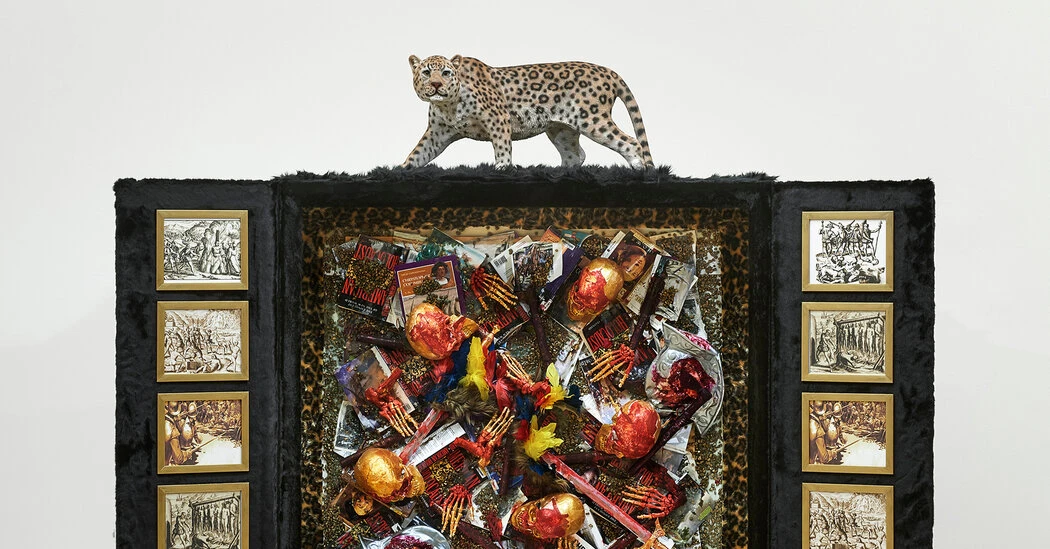
The show divides Mr. Montañez Ortiz’s career into four periods centered on a rich collection whose title pulls no punches: “The Memorial to the Sadistic Holocaust Destruction of Millions of Our Ancient Arawak-Taino-Latinx Ancestors Begun in 1492 of Columbus and his mission to, with the Conquistadores, colonize the wealth of the New World and deliver it to Spain, regardless of the human cost to the less-than-human natives of the New World.”
The first section is Destruction, which contains films he made by randomly cutting and piecing together short documentaries and performances in which he dissects pianos with an axe. Next up is Decolonization and Guerrilla Tactics, which delves into the Brooklyn-born artist’s Puerto Rican heritage and activism, including the founding of El Museo del Barrio.
This is followed by ethnoaesthetics, a word he coined to describe resistance to cultural ethnocentrism. The last is Physio-Psycho-Alchemy, which shows how he integrates meditation and ritual into performances. This section also includes digital videos he made in the 1980s.
El Museo curator Rodrigo Moura organized the exhibition with guest curator Julieta González. “It’s been in the works for a long time,” said Mr. Moura. “I’ve been at El Museo for three years and this is one of the shows I wanted to do as soon as I arrived. It is part of a re-evaluation of some of the museum’s defining values and history.
Mr. Montañez Ortiz’s works are in the permanent collections of two dozen museums across Europe and the United States, so curators are borrowing works from institutions such as the Museum of Modern Art and the Whitney Museum of American Art to assemble the exhibition New York, the Menil Collection in Houston, the Everson Museum of Art in Syracuse, NY, and the Chicano Studies Research Center at the University of California, Los Angeles. This last institution houses Mr. Montañez Ortiz’s manifestos and photographs of his performances, including his renowned participation in the Destruction in Art Symposium in London in 1966.
In addition to stoking interest in Mr Montañez Ortiz, 88, who recently retired from Rutgers after 50 years, most recently as a distinguished professor of fine arts, Mr Moura said he believes the show will renew El Museo’s ties to the city will. “It’s part of my curatorial interest to revisit and reconnect a new generation of museumgoers with this history of El Museo, and in this case with the work of its founder,” he said.
Mr. Montañez Ortiz graduated from the Pratt Institute in Brooklyn in 1964, just as New York was asserting its status as the center of the art world and people were opening up to the idea that art could be more than painting and sculpture. Mr. Montañez Ortiz was then engaged in traditional abstract painting and drawing, but lengthy discussions with the Dadaist writer Richard Huelsenbeck, an early advocate of the young artist, helped Mr. Montañez Ortiz find a highly intellectualized approach to what constitutes art. He concluded that it need not conform to traditional notions of “creation” and could include “destruction” as a means to reflect humanity’s violent tendencies.
Mr. Montañez Ortiz wrote a manifesto on “destructivism” as an art form in 1962 and four years later was invited to the Destruction in Art Symposium in London, where he made headlines by dispassionately dismantling a piano with an ax while the audience looked on. At other times in other places he destroyed chairs and other furniture.
The destruction belied the artist’s deep spirituality, which he gained from growing up in a Puerto Rican enclave on Manhattan’s largely Jewish Lower East Side. “I was open to so much spirituality,” he recalled in a phone interview. He came to know and appreciate the high episcopal faith of his father, his mother’s Catholicism and the orthodox Judaism of his neighbors.
“What was really important to me was to discover that in Judaism you can argue with God and in Christianity you’re better off not,” he said.
Mr. Montañez Ortiz said when he was a boy a rabbi told him about a couple who lost their daughter to polio. The couple spent most of their lives on a tête-à-tête sofa, where they felt the presence of their beloved child. After the parents’ deaths, the rabbi said the sofa retained a warmth and luster that led many people to believe that the spirits of the family remained. Mr Montañez Ortiz said destroying furniture is a way to “release a spirit as part of a reconciliation”.
While museums feature more women and artists of color than they did in 1969, institutions like El Museo are still important, said Noriega of UCLA in New York.
“It’s not like they need to see a gallery that only has Latino art,” he said, “but they need to come out at the end of a museum visit feeling like we’re up against the wall. And we belong in the world, because what hangs on the wall is a reflection of the world.”
The message resonates with great philanthropists. The Ford Foundation awarded El Museo a $4 million grant in 2020, and a year later author and philanthropist MacKenzie Scott donated $8 million, the largest single donation in the museum’s history.
The grants helped alleviate El Museo’s ongoing financial challenges by allowing the institution to launch programs it might not otherwise have had the resources for.
“This is a long overdue exhibition for the museum as the last time it presented a retrospective or major presentation of Raphael’s work was in 1988 and he has produced fantastic work since then,” said Mr Moura.
It’s not easy for a museum to adequately present a retrospective of an artist whose work ranges from haphazardly assembled films to methodically disassembled pianos to an embrace of spiritism and defiance of the cultural disenfranchisement of Latinos.
“His work benefits from being displayed in a museum context where people can understand his career as a whole and view the work from different moments,” said Kevin M. Hatch, associate professor of art history at Binghamton University. “It emerged in an era, the 1950s and 1960s, when artists were really pushing the boundaries of what could be considered art. He made a lot of these artists look conservative because he was pushing the envelope.”
“The art world has finally caught up with him,” added Mr. Hatch, “and I think this is really a beautiful moment for him to gain recognition that he may not have had along the way.”