
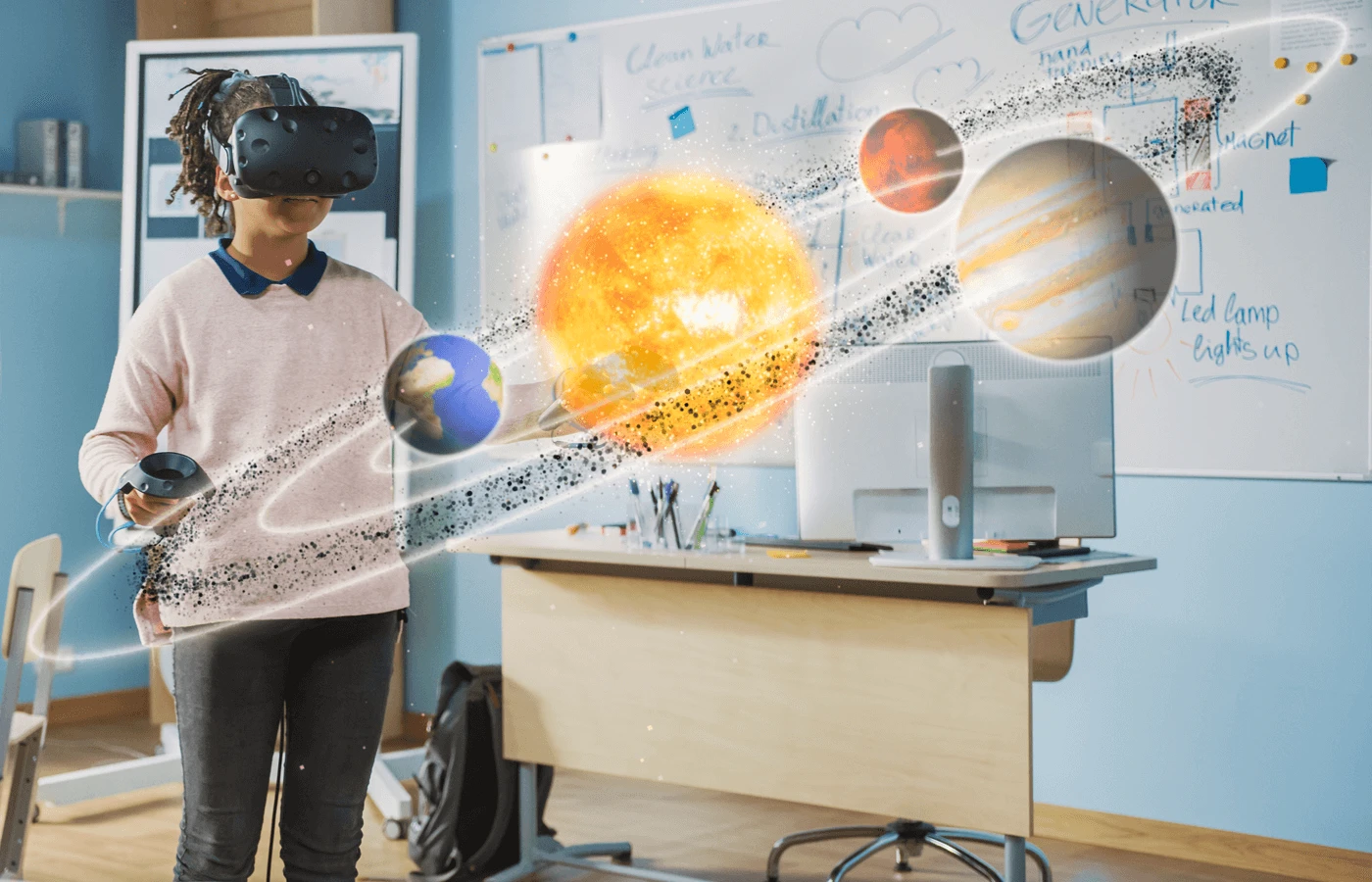
It’s hard to decide which of the recent “Metaverse” headlines have felt more unreal.
On the one hand, consider Facebook’s renaming to Meta – a nod to the shared virtual spaces in which the company sees its future. In this vision, large groups of individual users meet in an immersive, simulated, digital environment where they work, study, create, and form relationships that mix avatars and real-world elements to varying degrees. On the other hand, there was Meta’s subsequent 60-second Super Bowl commercial, which featured an animatronic dog reunited with its animatronic friends in virtual reality, and cost the company an estimated $13 million.
Either way, both showed that the hype surrounding the Metaverse is real, even if the Metaverse itself doesn’t even exist yet. Within two months of Facebook’s transition to Meta, Google searches for “metaverse” increased roughly 20-fold and the term was mentioned in 12,000 English-language news articles. The year before, it had been mentioned just 400 times.
Educators excited about the future of technology have not missed a beat and have jumped on the Metaverse train too. The Brookings Institution released a policy statement warning that “when education lags behind digital leaps, technology, not educators, will define what counts as educational opportunity.” The authors recommend that while the metaverse is still in the making, researchers, educators, policymakers, and digital designers should stay ahead of the trend.
What is the metaverse?
The exact definition of the metaverse is still up for debate. The term was coined by Neal Stephenson in his 1992 science fiction novel snow crash. The most widely used definition today came from venture capitalist Matthew Ball, who reduced it to seven elements.
In this understanding, the metaverse:
• Is always present and has no end
• Can be experienced synchronously by several people
• Has no population cap and can be shared by all while each individual retains their freedom of choice
• Can offer a fully functioning economy
• Can span both the digital and physical worlds, as well as open and closed platforms
• Is interoperable, so digital tools and assets from one app can be used in others
• Includes content and experiences created by a range of contributors.
According to technology author Ben Thompson, the Internet fulfills all of these requirements. “What makes ‘The Metaverse’ unique,” he writes, “is that it’s the internet that’s best experienced in virtual reality. However, this will take some time; I anticipate that the first virtual reality experiences will be individual metaverses linked together by the internet as we experience it today.”
There are lively discussions about this. Some wonder how interoperable the Metaverse needs to be. For example, how important is it that a digital tool that works in one video game can be used in another application? Do we need standard protocols such as those governing blockchain, or the open-source databases that underpin the current “open web”?
Because of the complexity, it’s easy to default to extended reality—virtual reality and augmented reality—when discussing the Metaverse. But as much as the mobile internet built on the infrastructure of the internet, Mark Zuckerberg and others at Meta argue that the Metaverse will simply be the successor to the mobile internet.
More than Web 3.0
This isn’t the first time educators have gotten excited about virtual reality, nor is it the first time I’ve written about it on these pages (see “Virtual Reality Disruption: Will 3-D Technology Reach the Education Mainstream?”). ) What now, autumn 2016). Remember educators’ short-lived obsession with Second Life, the online platform where people create avatars to navigate a 3-D online world? That excitement quickly evaporated, and Second Life was retired along with many other educational fads.
What’s different this time?
For starters, interest in the Metaverse is rising amid a long, deeply disruptive pandemic that has sparked an unprecedented, rapid deployment of virtual learning around the world. According to the Digital Learning Collaborative, 375,000 students were enrolled in full-time virtual schools nationwide in the 2018-19 school year. By the 2020/21 school year, the number had almost doubled to 656,000 students. This count does not include virtual schools run by local districts, which have also grown dramatically during the pandemic. And many students enrolled in traditional school schools are now regularly studying portions of the day online, either at school or at home.
This has removed one of the main barriers to using virtual reality in the classroom: equipment. In the past, logging into a laptop and wearing a virtual reality headset was considered an intrusive ordeal. But the game has changed, according to Thompson. If students already do a significant portion of their work online, why not wear a headset most of the time?
In this vision, a virtual reality headset is just an everyday accessory, like a computer mouse. But with it, students can “enter” various educational seminars and co-working spaces for projects and experience a range of virtual reality environments, learning applications, lectures and more. Just as the increasing popularity of now-familiar learning technology tools like laptops has fueled the development of online learning applications and environments, this momentum, coupled with a broader interest in the metaverse, appears to be driving the creation of more learning environments that take advantage of virtual reality and 3D
In development
Dozens of Metaverse-type experiments are underway in K-12 training.
For example, the American High School advertises its virtual reality offerings on its website. The accredited, private online school has been in operation since 2004 and has enrolled more than 8,000 students in grades K-12. Later this year, students and teachers at Optima Classical Academy, an online charter school based in Florida, will meet as avatars in a virtual reality social platform created for the school, which its founder dubbed the “Metaverse.” . It is slated to launch in August for students in grades 3 through 8 who will follow a great books curriculum. Women Rise NFT, a collection of one-of-a-kind digital artworks by artist Maliha Abidi, was founded with the ultimate goal of building a school in the Metaverse to serve the 258 million children around the world who have no access to traditional schools.
There are also plans to support educators through the Metaverse. The company k20 launched the Eduverse, a “metaverse hub for educators” to connect teachers and administrators in a shared virtual world where they can learn, connect and advance in their careers.
Finally, there are a number of enablers and complementary providers that provide virtual reality experiences for students and educators. Companies like Labster offer virtual reality labs, and FluentWorlds allows students to learn English in a variety of virtual worlds. Kai XR offers 360 degree virtual field trips and EDUmetaverse has over 35 virtual worlds for educators to use.
And think of Dreamscape Immersive, a virtual reality company founded by computer scientists and former Disney executives. While its main sponsors are from the entertainment world — major Hollywood studios, Steven Spielberg, Nickelodeon, and AMC Theaters, which plans to co-place Dreamscape virtual reality experiences in some of its theaters — the company also has a partnership with Arizona State University closed to create Dreamscape Learn. His first offering, a series of virtual reality labs titled “Immersive Biology at the Alien Zoo,” was developed by Spielberg and the company’s CEO, Walter Parkes, as an alternative to traditional lab work in college-level introductory biology. A high school diploma is planned for later this year.
And even Meta has a team dedicated to developing educational applications in the Metaverse.
looking ahead
As the Metaverse mania continues, three things seem to be true.
First, innovation theory suggests that the early successful instances applying elements of the metaverse will be proprietary in nature. They are first optimized to maximize the performance and reliability of an immature technology at the expense of scalability and interoperability. This immediately indicates a problem. Many of the instances referred to as metaverses fail to meet a key criterion of Ball’s definition: interoperability. In fact, much of what currently passes for Metaverse hype is still virtual reality dressed in new marketing language.
However, this might not be a bad thing considering if the metaverse will be a safe and healthy place for children. Walled garden experiences — think Prodigy and America Online, not the entire World Wide Web — might be safer, at least initially, even if it might temporarily undermine the vision of innovative instructional or skill development through the blockchain or decentralized autonomy organizations.
Second, the metaverse appears to be a supportive rather than a disruptive innovation for full-time virtual schools. As opposed to disruption, sustained innovation improves the performance of an existing product or service to better serve existing users. Full-time virtual schools, which sometimes struggle to engage students, would likely benefit from a more immersive, social experience. Combining their programs with the Metaverse as well as personal learning capsules could create a more robust and accessible school experience. Alongside the flexible learning models that have taken root during the pandemic, like pods and hybrid online and face-to-face programs, a socially rich, immersive metaverse could eventually disrupt traditional, brick-and-mortar schools.
Finally, Metaverse applications can create educational experiences otherwise impossible in a traditional setting. Virtual Reality can bring content to life with dynamic imagery and hands-on digital exploration. It can bring real people and knowledge from other parts of the world to classrooms anywhere. Consider the potential for science labs, language learning, internships, cultural exchanges and field trips (see “The educational value of field trips”, Research, Winter 2014).
When the metaverse comes into the classroom, these are the areas to aim your virtual reality goggles at.
Michael Horn is Executive Editor of education next, Co-Founder and Distinguished Fellow at the Clayton Christensen Institute for Disruptive Innovation and author of forthcoming book From reopening to reinventing.