
art market
Brian P. Kelly
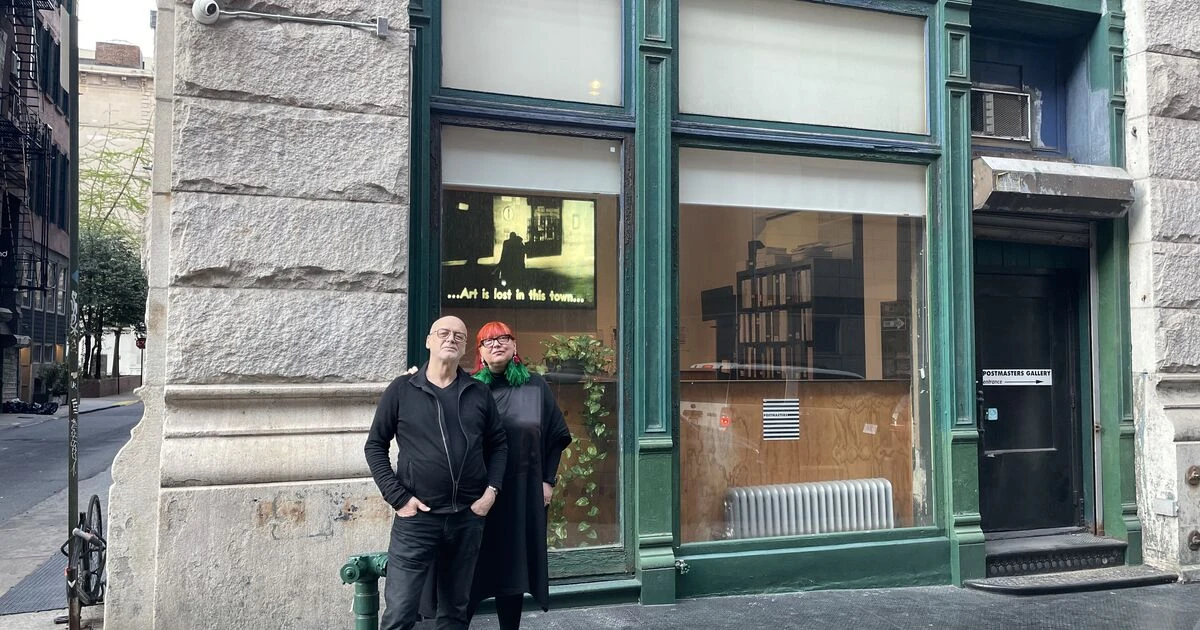
Founders Tamas Banovich and Magda Sawon in front of postmasters.
On Tuesday, the famous New York gallery Postmasters announced in an email that its current exhibition would be the last at its Tribeca premises. Magda Sawon and Tamas Banovich, who co-founded the gallery nearly four decades ago, wrote that they were vacating “at very short notice” after “losing a protracted legal battle with our landlord over a Covid lease”. There are no plans for a new storefront, but the gallery plans to go nomadic in a format dubbed Postmasters 5.0.
Speaking to Artsy, Sawon declined to go into detail about the real estate situation as the court case is pending. However, she pointed out the irony that Tribeca’s booming gallery scene — and the sky-high rents that come with it — are due at least in part to Postmasters’ longstanding presence in the area.
“We were one of the first [galleries] here in Tribeca in 2013 – basically the first relocating gallery from Chelsea. There was nobody here, so we were a target ourselves, and then the neighborhood gradually filled up with more galleries,” she said. “Now it’s packed with galleries, and more are coming,” she added, explaining that the influx of eager tenants means landlords have a lot of power.
Installation view of the Can You Digit exhibit at Postmasters in 1996. Courtesy Postmasters Gallery.
The gallery has always been at the forefront of digital and conceptual art in New York. Aside from being a pioneer of the Tribeca scene, its previous locations — first the East Village, then SoHo, then Chelsea — have been at the forefront of artistic transformation of various neighborhoods. Similarly, the gallery has a proven track record in terms of the types of work on display. There have been early exhibitions for acclaimed conceptual and new media artists such as Paul Ramírez Jonas, Alix Pearlstein, Spencer Finch, Omer Fast, Rafaël Rozendaal, Austin Lee and Hugh Hayden, among others.
Additionally, the 1996 exhibition of screen-based art, Can You Digit, was historic because it presented digital art with the same seriousness as more traditional forms. It included work by Craig Kalpakjian, George Legrady, Lev Manovich (now better known for his writings on digital culture) and Erwin Redl, and a surviving website for the show is itself a digital artifact, including its information for potential collectors: ” Most works are available on diskettes or CDs, special editions. please inquire by email, fax or phone.”
Also of note is that Postmasters, particularly now in 2022, has a long-running digital art program – which will continue unchanged after the gallery vacated its physical space. The gallery was an early adopter of NFTs and has worked with leading artists in the field such as Jennifer and Kevin McCoy who created one of the first art NFTs.
Postmasters’ departure may be reminiscent of similar high-profile reshuffles caused by the pandemic: Gavin Brown’s Enterprise closed in July 2020, and its founder joined the Gladstone Gallery team; and in December 2021, Metro Pictures closed after 40 years. However, Sawon is aware that this is simply the birth of a new iteration of the gallery, which she calls “Heaven and Hell”.
Installation view of Kenneth Tin-Kin Hung’s exhibition The Travelogue of Dr. Brain Damages” at Postmasters in 2011. Courtesy Postmasters Gallery.
Finding a smaller space was never an option for Sawon — “shrinking down,” as she put it, wouldn’t feel right “after 38 years of pushing different boundaries all the time.” She believes nomadism offers a more sustainable model than maintaining a stationary space. “I’m sure a lot of other galleries are feeling the same way right now,” she said, noting, “there’s this battle between what sells and what you think is amazing. The Venn diagram between the two isn’t always that great.”
She also explained that the decision to go nomadic stemmed from her refusal to compromise on the gallery’s programming. “We really have a very clear idea of what kind of art we’re interested in and what kind of art we want to show,” she said, which “kind of a new model for running a gallery — and running a gallery in particular — requires gallery that shows sophisticated and forward-thinking art.”
On a practical level, Sawon plans to look for open spaces that complement the shows she plans to do—smaller spaces for more intimate presentations, larger ones for more expansive exhibitions. She was quick to point out that these would be expanded exhibits, not pop-up shows, which she dubbed “flash mob exhibits.”
While she has yet to finalize venues for future shows — she said she currently plans to narrow her search to Manhattan — two exhibitions have been announced for the fall: “a monumental, groundbreaking show by BarabasiLAB about networks and data as a new realism…and a large-scale multimedia project by the remarkable collaborative team of Jen Catron and Paul Outlaw.” The former, also known as the Center for Complex Network Research at Northeastern University, will be working with the gallery for the first time, while the latter duo has been represented by Postmasters for several years.
Installation view of LoVid’s hold on exhibition of digital tapestries and NFTs at Postmasters in 2022. Courtesy Postmasters Gallery.
Sawon said she’s most excited about the opportunity to be “a little bit more improvisational and a little bit looser.” Now that she no longer has a static physical gallery, her calendar can be less regimented, she can choose spaces that best suit the work she is showing rather than being constrained to a set architecture – and she is inspired by the ” exorbitant” rent, whom she called “an albatross”.
But being on the road also brings its own challenges, particularly informing visitors and getting them to show up. She hopes Postmasters’ track record on this front will pay off. “I think over the years we’ve built a specific audience for the gallery, so we have a specific currency that will intrigue people enough to see the next thing we do,” she explained.
Just as important to her, however, is to use this model to maintain the sense of community that has grown around the art itself. “A gallery [is] more than a place to sell art to collectors,” she said. “I am in love [the] Audience. I love the fact that people come and see and aren’t here to buy.” It might not be the feel you’d expect from a gallery going nomadic to cut costs, but it is Reference to Sawon’s dedication to raising the profile of the artists she cares about. “They are here to see and experience the artworks,” she continued. “I think that’s the most amazing and exciting thing you can offer, and somehow I have to support that notion if we think that’s important.” With Postmasters 5.0, she’s attempting to do just that.
Brian P. Kelly
Brian P. Kelly is the Art Market Editor at Artsy.